
According to the Merriam-Webster dictionary, a tree is “a perennial woody plant, featuring a single main stem or trunk, and supporting branches and leaves well above the ground. There is no single scientific or botanical group for trees; rather, being a tree is an evolutionary survival strategy that helps plants reach sunlight.”
Those of us who look at trees all day long know better. There are two trees that I can see through the window near my dining-room table, where I am writing this answer:
One, a sycamore maple (Acer pseudoplatanus), a European species known simply as the “sycamore” tree in the U.K. and transplanted to my hometown of St. John’s, Newfoundland, Canada, as a garden ornamental around the turn of the 20th century. This particular specimen has three large main trunks and at least two small ones sprouting from near the bottom of the tree.
A multi-stemmed American Mountain Ash
Two, an American Mountain Ash (Sorbus Americana), or Dogberry as it is known here in Newfoundland, closely related to the Rowan tree that is known as a powerful protector in Celtic and Norse folklore. This particular specimen has three main trunks, too, at least six more smaller ones, and plenty of leaves that are no more than a foot or two from the ground in addition to some higher up. It’s also bent dramatically toward the East in the direction that the wind sweeps down the hill toward the harbour.
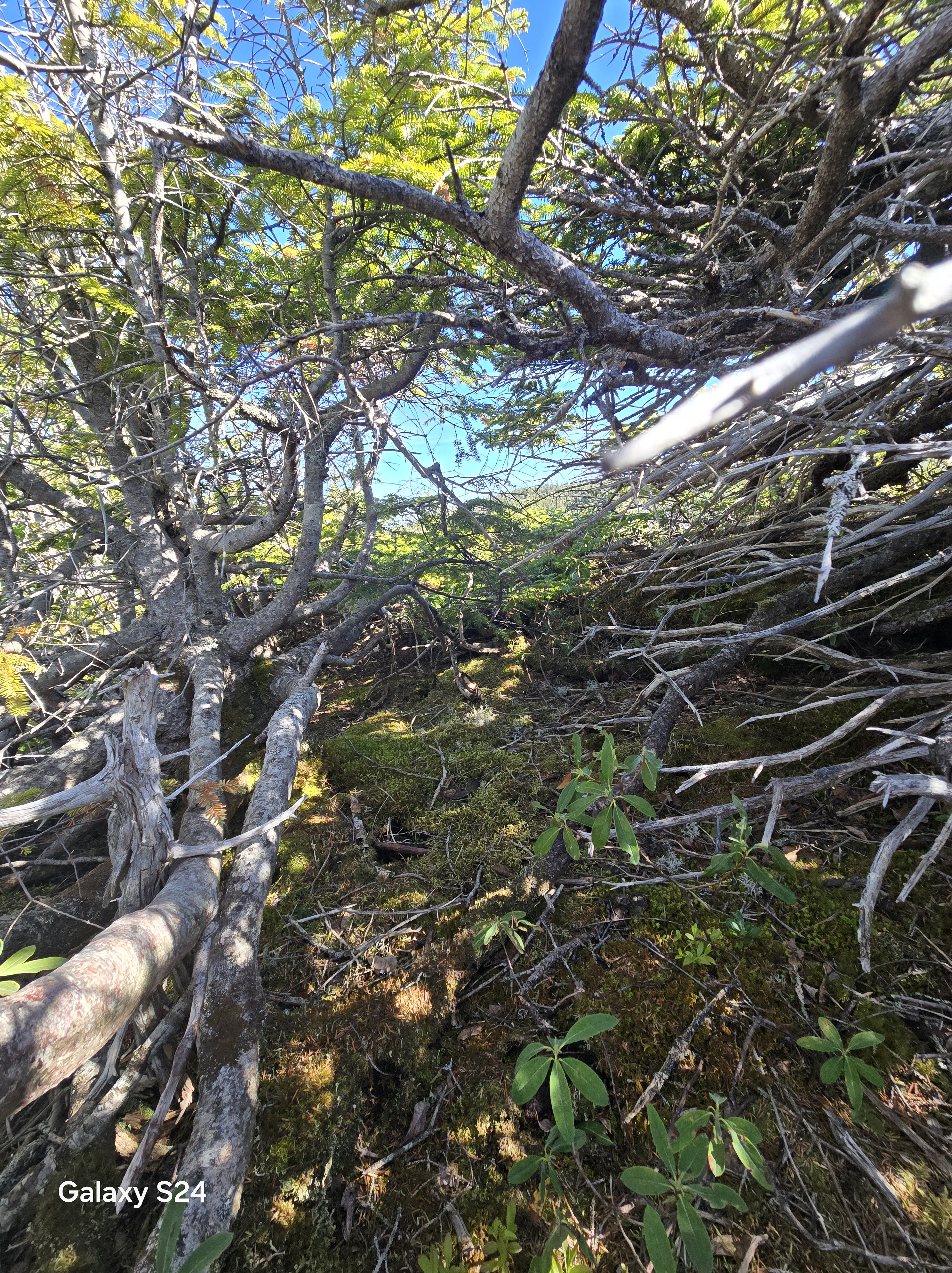
Trees growing as tuckamore or krummholz near the Deadman’s Bay trail
On the Deadman’s Bay segment of the East Coast hiking trail a few kilometres from here, black spruce and balsam fir trees grow in dense, twisted, intertwined shrubby mats near the ground as a response to extreme wind conditions. In this exposed place, lack of sunlight is not an issue but wind damage is a major challenge for trees.
Firs and spruces are not the only trees that are stunted in this place. Tamaracks have branches hugging the ground, and even alder trees, which tend to be small anyway, grow in miniature forms. As you descend into small protected “valleys” below the exposed bedrock, the trees will suddenly be taller, as they are protected, there, from the unrelenting wind.
Larch (tamarack) tree stems hugging the ground near the Deadman’s Bay hiking trail
In the mealy mountains of Labrador, in 2010, a biology graduate student from the Memorial University of Newfoundland found a black spruce tree that was only 2 metres tall and 10 centimetres in diameter—at 370 years of age!
In less extreme conditions, in a protected meadow at the bottom of a hill near a local pond and wetland, coniferous white spruce trees will have pendant branches with leaves (needles) nearly all the way to the ground, with just enough room underneath for a snowshoe hare to find shelter.
Perhaps under some kind of “ideal” conditions a tree might resemble its dictionary definition. But what would those ideal conditions be? As stated in the dictionary definition itself, even the “ideal” single-stemmed, tall, straight form evolved in response to stress—namely the need to get enough sunlight, presumably in thick forest conditions where other trees are competing for access to open sky, too. So trees did not evolve under ideal—that is, easy and uniform—conditions. Not even those stereotypical forest trees have ever had it easy. If they hadn’t had to fight for sunlight and yield to wind and avoid cracking in freezing temperatures and deal with water shortages and poor soil and insects and fungi and other stresses, they wouldn’t have evolved into trees in the first place. So the “ideal” tree defined as the one with the easiest life cannot be our definition of what a tree is.
The second part of Merriam-Webster’s definition—that trees are not a botanical grouping but an evolutionary adaptation—is more accurate than the first part. But it only helps a bit. That’s because there is no clear dividing line between what is a tree and what is a shrub, and there never will be, because nature hasn’t created those categories—we have. That tall, thick sycamore maple with tree stems in my backyard is definitely a tree, to me. It isn’t a shrub because it has three main stems. Similarly, the tiny, dwarf balsam fir growing by the Deadman’s Bay trail is a tree, even though it may never grow more than a few feet tall. A serviceberry may be considered to be a shrub or a tree, depending on whether it has more than one stem or not. Most people consider the American Mountain Ash to be a tree, but more often than not it grows as a multi-stemmed large shrub. At what stage does it change categories? Exactly how stunted and twisted does a black spruce tree have to be before it becomes a shrub or part of a shrub or simply a ground cover?
And how many of the beings we would definitely think of as trees actually have a single trunk? Many trees species, including the American Mountain Ash and the Gray Birch, have multiple main stems more often than they have a single stem. Yes, most trees will initially sprout with a single stem, and in the absence of any damage to the apical bud (the bud at the tip of the original stem) will have a single trunk. However, relatively few trees actually manage to avoid sustaining damage to their apical buds or trunks through their decades or even centuries of life.
Pando: 47,000 “trees” with a single root system
And what about trees that spread through underground root systems to form clonal colonies? The largest known example of this is Pando, in Utah, a single organism with around 47,000 “tree” trunks over dozens of acres but with a single, massive quaking-aspen root system that keeps sending up more stems. Is this one tree or 47,000 trees?
You will see more needle-bearing conifers than broadleaf trees with single trunks because these conifers cannot grow new stems if their apical buds are damaged; instead, a side branch may grow upward toward the sunlight, taking over the job of the damaged main stem. (Even some conifers, such as black spruce, can spread vegetatively by layering, when lower branches touch damp ground and put down new roots.)
Broadleaf trees do things differently. They possess numerous epicormic (under-bark) and adventitious (root-collar) buds, which can remain dormant for many years until they are activated by traumatic damage to the tree. They will then spring to life, creating multiple new branches or stems for the tree. This is why you often see trees with two, three, or even nine or ten main stems rather than one. This natural process is called “coppicing,” and traditional peoples around the world took advantage of this property of hardwood trees to obtain the large amounts of wood they needed for everything from basket-making to fence-building and charcoal making (indispensable to the blacksmith’s craft) for millennia.
The near disappearing of coppicing as a practice is due to the shift in forestry toward softwood production. Because softwoods (needle-bearing conifers) work better for the large-scale production of pulpwood (for paper) and construction lumber and lend themselves more easily to mechanized harvesting for large-scale harvesting, modern forestry has basically forgotten about hardwood trees. Modern foresters and logging companies plant mile upon mile of pines, spruces, firs, and larches, all equally spaced and of the same age.
Stereotypical tall, straight forest conifers
Perhaps it is these homogeneous softwood plantations and the priorities of their managers that have given us our modern definition of a tree.
Which goes to show that the way we divide up the world says more about us than it does about the world we think we understand. Trees do what they need to do to survive under enormously variable conditions. They do not care a whit for our categories or definitions.
Leave a Reply